

In response to the recent mushroom poisonings in the news - what you need to know
We were very saddened to hear the news about the recent hospitalizations near Salinas due to Amanita phalloides (Death Cap) ingestion. Our thoughts are with those affected. (Please note, this was NOT related to one of our classes.)
The media often jumps on opportunities to heighten mycophobia (fear of mushrooms), and this case is no different. However, the existence of Amanita phalloides is not new information. There is not reason to be more concerned now than before. The best thing to do is to empower yourself with knowledge. Amanita phalloides is a mushroom that every forager should know well! Here’s how you identify it:
Cap: yellow-green cap color, sometimes has a brittle white patch on top, but not always
Gills: white, and all the same length
Stem: often has an annulus (also called a ring or skirt,) but not always, as it can fall off due to weathering
Base: bulbous white tissue (volva) that you must dig out of the ground to be able to see.
You can safely smell it, touch it, and you can even do a nibble-spit test (which we don’t recommend with this mushroom, BUT it supposedly tastes quite good, which tells you that just because a mushroom tastes good does NOT mean it’s edible!) You should never, ever ingest it. There are human and animal fatalities every year from this mushroom around the world.
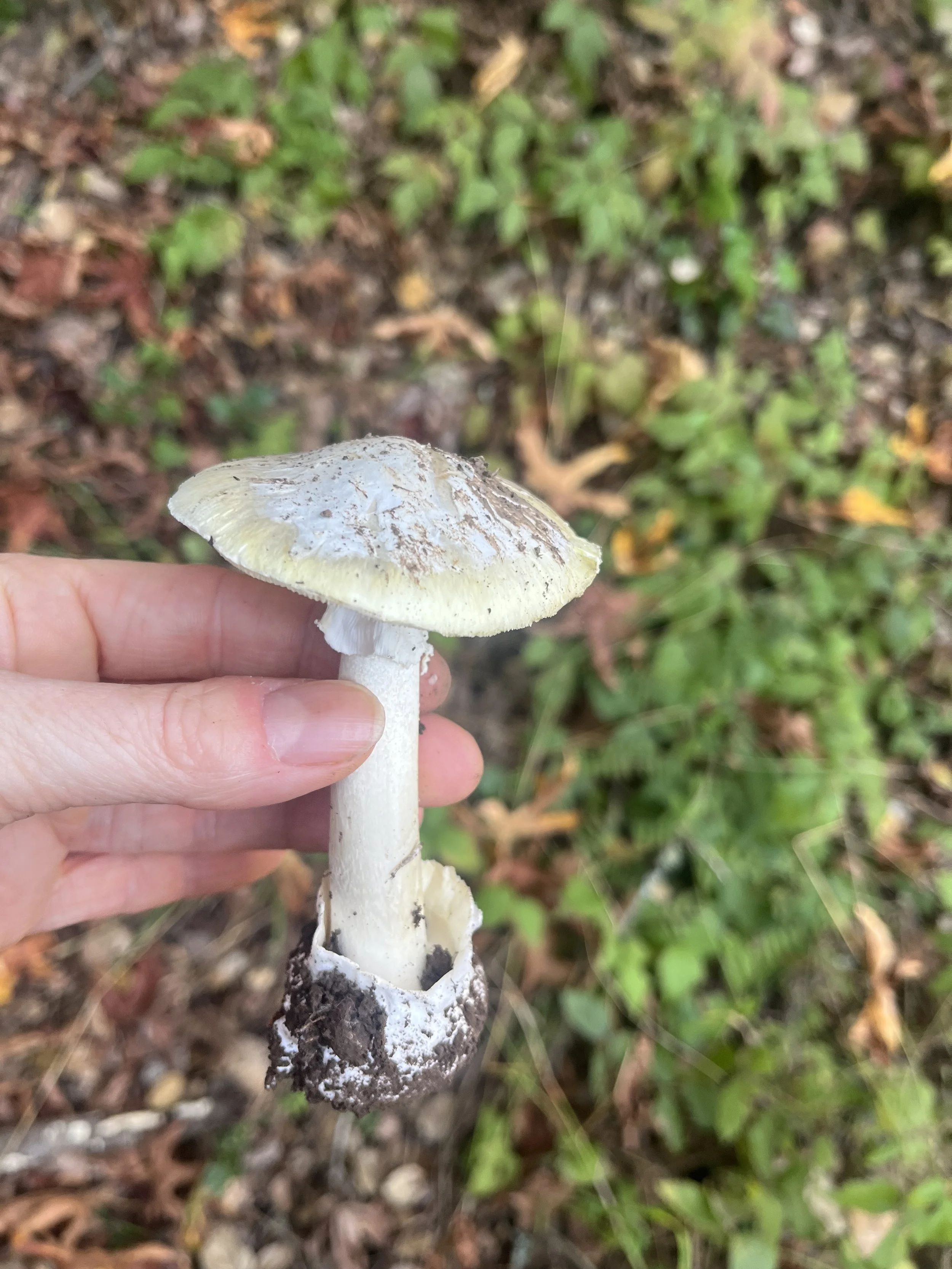
Pictured: Amanita phalloides (Death cap)
If we see it at any of our classes, we will most certainly emphasize it. Please be reassured that our highly trained guides will never send you home with a toxic mushroom, and in fact, we don’t recommend that beginners eat any mushrooms in the genus Amanita.
For all foragers, the essential rule is: When in doubt, throw it out, meaning, if you aren’t 100% sure what you have, DON’T eat it. But especially when you are a beginner, we recommend cross-referencing any new mushroom you’re learning with at least three of these sources so you can really get to know it:
1) A highly trained guide (such as one of Fork in the Path’s instructors)
2) A guidebook (like Mushrooms of the Redwood Coast)
3) An app (we recommend iNaturalist)
4) An online resource (like MycoWeb)
5) An identification group (like the California Mushroom Identification Forum on Facebook)
Every year, different species of mushrooms have good years when they are out in greater numbers. While we see Amanita phalloides every year, it is having an extra good year, which could have contributed to the uptick in cases. However, there are additional factors impacting the communities where these cases occurred that could be contributing to food insecurity.
Although we do not know all the details of these recent and unfortunate cases, we feel it is important to take the opportunity to reflect on the ways that socio-political circumstances can intersect with the work that we do, and thus strengthen our mission of fostering curiosity, reciprocity, and understanding of the natural world in our wider community.
In light of this, we are offering two free classes in Spanish on edible and poisonous mushrooms of California, and would appreciate your help in spreading the word:
Clase Gratuita Online en Español: Domingo, Dec 28th 5:45 pm - registraté aquí
Clase presencial gratuita: Roseland Libraria en Santa Rosa, Jan 7th 5:45 pm en Español y 6:45 pm in English (no registration required)
Please help us spread the word! You can also help by contributing to our scholarship fund for low-income community members to come learn with us. We’ve raised $2500 so far, and our goal is to raise $20,000 and be able to give away 2 spots in 100 classes.
We hope to see you at an upcoming class soon.
Update: It has come to light that the majority of folks hospitalized were experienced foragers from another country. What’s important to highlight here is that these folks thought they had made an identification of an edible mushroom they knew well in their home country. Mushrooms can have similarities across different geographic regions, but they are not necessarily the same. So the lesson for all of us is that even if you know mushrooms well in your own region, you cannot assume similar-looking mushrooms outside your region are the same!
