Foraging in the Sierra Nevada Mountains
written by staff instructor Christopher O’Maelmacasa aka @trashpandapermaculture
One of the most beautiful aspects about California is that, pretty much no matter where one calls home, you're only a few short hours from either the Pacific Ocean or the mountains. When it comes to mountain ranges, the Sierra Nevada is by far the most ubiquitous. Just under 450 mi long and fluctuating between 40-75 mi wide, it stretches from just below Lassen in the north to slightly east of Bakersfield in the south. Comprising nearly 25% of California's landmass, this range contains an astounding amount of flora and fungal diversity, many of which are additionally delicious. While the act of foraging connects us deeply to these lands, it's crucial to do so respectfully, legally, and with guidance to ensure sustainability.
Seasons & What To Forage
More so than perhaps any other geomorphic province, foraging in The Sierra Nevada is highly seasonal. Spring brings with it countless greens, herbs, and wildflowers such as Nettle, Rooreh, Violets, Ferns, and a personal favorite, Onions! Mushrooms also abound, with many traveling to our slopes in search of Morels. Unlike the flatlands, summer stays a bit cooler with various successions of wildflowers continuing their majestic bloom. Edible and medicinal species, including Columbine, Yarrow, fields of Mint, and Fireweed, cover entire hillsides. Fruits begin late and then extend well into Autumn.
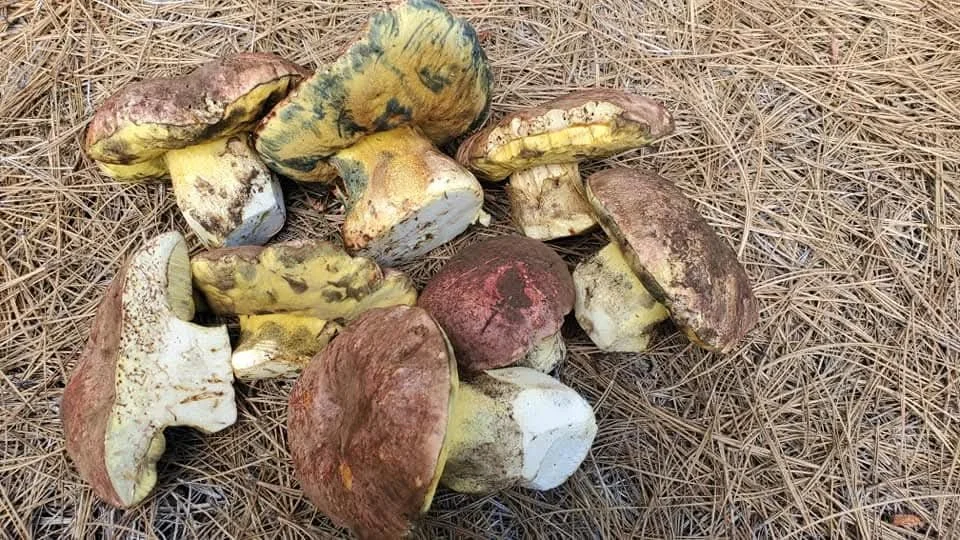
Ah, Autumn…fruit season. Nearly everywhere you look, there is a tasty treat awaiting you. Gooseberries, Thimbleberries, Serviceberries, Elderberries, Blackberries, and Raspberries! The list could go on forever. At this time, we also have an abundance of high-calorie foods such as acorns, seeds, and our numerous geophytes. If the rains are well-timed, many areas are also prime for Porcini mushroom picking!
As the weather turns cooler and precipitation begins to arrive in force, the Sierra Nevada's higher elevations largely come into a period of snow-covered hibernation. However, this is when the mushroom season at lower elevations really begins to pick up. Diversity explodes in the western foothills, with dozens of prized edible fungi showing up for the season.
Places To Forage
While most California State and National Parks have extremely strict policies when it comes to foraging, many of our National Forests are quite permissible. Generally, there is a permit to be acquired, and with it, a generous daily limit to harvesting. However, as we have ten National Forests within the Sierra Nevada alone, it is important to check with the specific location to plan to visit, as policy and regulations can vary between them.
Rules and Sustainable Practices
For us, we find that the best way to engage in sustainable foraging practices is simply building relationships with the local organisms where you happen to find your feet. Rather than having an arbitrary set of guidelines (ie, only take 10%), we base our interactions with the natural landscape on three levels: local ecological health, population abundance, and then the individual plant or mushroom which one plans to collect. First, we look at how healthy the ecosystem is. Will harvesting from a particular location be damaging or beneficial? Is there heavy human impact? Second, how abundant is the particular organism we wish to harvest generally and locally? Has its population been increasing or decreasing over time? Third, is the specific individual we are harvesting from in good health? What is the most regenerative way to collect from them?
In all cases, we look to see how we can reciprocate. Sometimes it's as simple as picking up any trash we see. On other occasions, we wait until the proper season so that we can spread seeds while also harvesting our food. In all cases, we are giving attention in order to better understand how our actions are impacting the land and organisms with which we are building relationships. Sometimes it can take years to see the footprint of your actions upon the land. Finally, never forage anything without an experienced guide until you are confident in identification and sustainable practices.
Hazards
Venturing into nature always comes with potential risks. On the west side of the Sierra Nevada, be highly vigilant for Poison Oak. learn to identify this plant in all its seasonal stages and always wear protective clothing. Ticks are also common at lower elevations. It is a good idea to check yourself and any furry friends thoroughly after traipsing through the woods. While there are a number of animals to be aware of, such as Mountain Lions and Black Bears, they are generally not a serious concern. However, it is always a good idea to be aware of your surroundings. Speaking of that, the risk of getting lost is something to be mindful of, especially when exploring new or dense areas. Use a GPS or mapping app such as Gaia, OnX, Avenza, Caltopo, or AllTrails that works in or out of reception, and inform someone of your planned route and expected return time. Many areas have a complete lack of cell reception, so plan accordingly! Along those lines, more so than any other region, weather in the mountains can change rapidly. Always check conditions before you head out, and be sure to dress in layers. Safety should always be your top priority.
Learn
Beyond Fork in the Path classes, you can engage with the foraging community through local events and organizations. The Yuba Watershed holds a weekend fungal foray every year in early December. Organizations such as Trashpanda Permaculture, Tahoe Institute for Natural Sciences (TINS), and both the California and Nevada Native Plant Societies hold various field trips and volunteer opportunities throughout the year and are great places to learn and connect with fellow naturalists.
Acknowledging Indigenous Lands
The Sierra Nevada is the ancestral and traditional lands of numerous Indigenous groups such as the Wašiw, Sierra Me-Wuk, Maidu, Mono/Paiute, Yokuts, Tubatulabal, and many others. We acknowledge these Indigenous peoples who have stewarded this land for generations, and whose deep knowledge of its bounty continues to inform our understanding and respect for nature. Examples of local groups you can get involved with are the Washoe Tribe, Tuolumne Band of Me-Wuk, Feather River Land Trust, and Bear Yuba Land Trust.